On this page
The short version
- ChromeOS 156 ships strictly as a “General enhancement release,” freezing feature development to patch Chromium engine vulnerabilities and stabilize the OS tree.
- The mandatory migration to the Certificate Provisioning API (SCEP) has been delayed to June 2027, saving fleets from hardware-bound certificate failures.
- Google is altering the Omaha update mechanics for Isolated Web Apps (IWAs) in M159, finally allowing deterministic, user-triggered updates for Signed Web Bundles.
If you are tracking the Chromium commit logs, you already know that the shift to an even-numbered OS release cadence (154 → 156 → 158) means some updates will be heavy infrastructure hauls, while others act as stabilization anchors.
According to the official ChromeOS 156 release notes, this milestone falls squarely into the latter category. Classified by Google as a “General enhancement release,” ChromeOS 156 ships with zero new user-facing features. Instead, the engineering focus is entirely on patching Common Vulnerabilities and Exposures (CVEs) in the Chromium engine and stabilizing the OS layer.
However, for enterprise architects and kiosk developers, the release notes contain two critical updates regarding zero-trust networking and web app architecture. Here is a technical breakdown of what is actually changing under the hood.
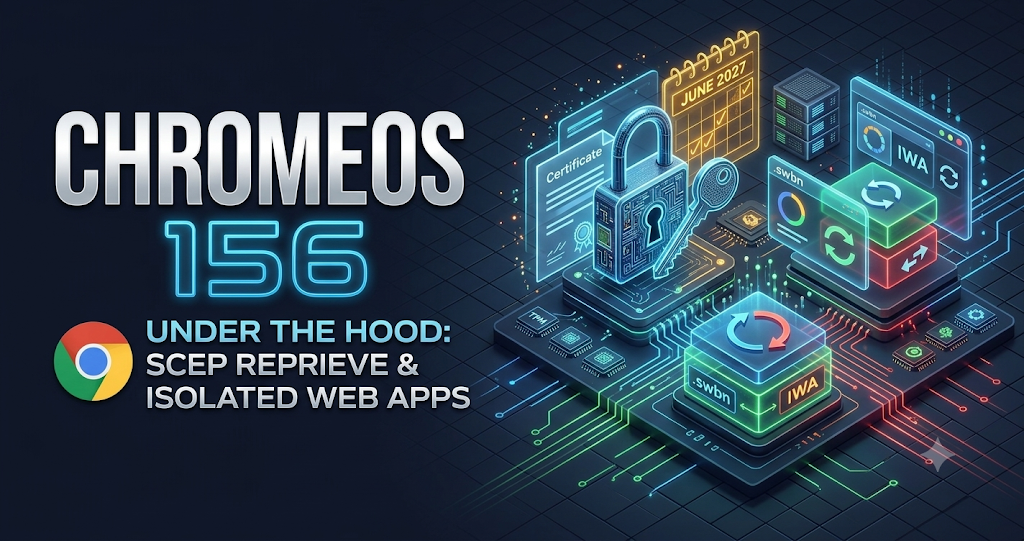
1. The SCEP Reprieve: Certificate Provisioning API Cutoff Extended
Legacy certificate deployment on ChromeOS used to be relatively blunt: IT admins would push network and VPN certificates directly to the device. The problem? That approach doesn’t align with modern Zero Trust Network Access (ZTNA) architectures, which demand that private keys be cryptographically bound to the device’s hardware security module (like a Chromebook’s TPM or Google’s Titan C chip).
To fix this, Google has been deprecating legacy deployments in favor of the Certificate Provisioning API. This modern pipeline uses the Simple Certificate Enrollment Protocol (SCEP). Instead of the server sending a full certificate, the ChromeOS device generates a private key inside its hardware enclave, generates a Certificate Signing Request (CSR), and sends it to the SCEP server. The private key never leaves the silicon.
Google originally set an aggressive timeline to force this migration. However, the ChromeOS 156 notes confirm that the mandatory migration deadline has been extended to the end of June 2027.
Why this matters for IT Architects:
- The Cliff Edge: At the end of June 2027, ChromeOS will completely sever support for certificate enrollment outside the Certificate Provisioning API. If your MDM or network infrastructure isn’t updated, devices will fail to authenticate to 802.1x Wi-Fi networks and corporate VPNs.
- The Runway: This extension acknowledges the sheer complexity of ripping and replacing enterprise Public Key Infrastructure (PKI). Architects now have an extra six months to configure their Microsoft NDES or Cisco ISE environments to support ChromeOS SCEP payloads.
2. Unboxing Isolated Web Apps (IWAs): Deterministic Updates Arrive in M159
Standard Progressive Web Apps (PWAs) are great, but they are intrinsically tied to the live web. For highly secure enterprise environments—like point-of-sale (PoS) kiosks, healthcare terminals, or offline-first admin tools—Google introduced Isolated Web Apps (IWAs).
Architecturally, an IWA is packaged as a Signed Web Bundle (.swbn). It runs in a strict isolated context, cannot load cross-origin resources, and is subject to a rigorous Content Security Policy (CSP). Because of this isolation, IWAs are granted powerful Web APIs (like Direct USB, Serial, and HID access) that standard PWAs are denied.
The Update Problem: Until now, IWAs updated exactly like Chrome extensions. The OS’s background update engine (Omaha) would silently poll the server, pull down the new Signed Web Bundle, and swap it out in the background. For enterprise developers, this lack of deterministic control was a nightmare. You couldn’t force a kiosk to update instantly, nor could you notify a user that an urgent patch was waiting.
The M159 Fix: Google is officially exposing the update mechanics. As early as ChromeOS 159, both managed and unmanaged users of IWAs will be able to:
- Trigger Manual Polling: Force the OS to ping the update server for a new
.swbnmanifest immediately. - Surface Update Notifications: Hook into OS-level notifications to alert the user/admin that a new bundle is ready.
- Force Immediate Execution: Bypass the background-wait queue and install the IWA update instantly.
While silent background updates will remain the default, exposing these manual triggers gives enterprise developers the lifecycle control they have been begging for since IWAs were introduced.
The Bottom Line
ChromeOS 156 isn’t going to make headlines for flashy UI changes. But in the enterprise world, a stable OS tree paired with a massive extension for a breaking PKI change is the best kind of news you can get.
We will be tracking the Chromium Gerrit closely as we approach ChromeOS 158. Keep an eye on our Release Tracker for the latest stable build drops.
The M156 Technical Verdict
Read this if
Skip it if

Rishu Mehra
Writes about ChromeOS, developer documentation, and cloud-first computing. Runs TheChromebooks.com as an independent publication.